
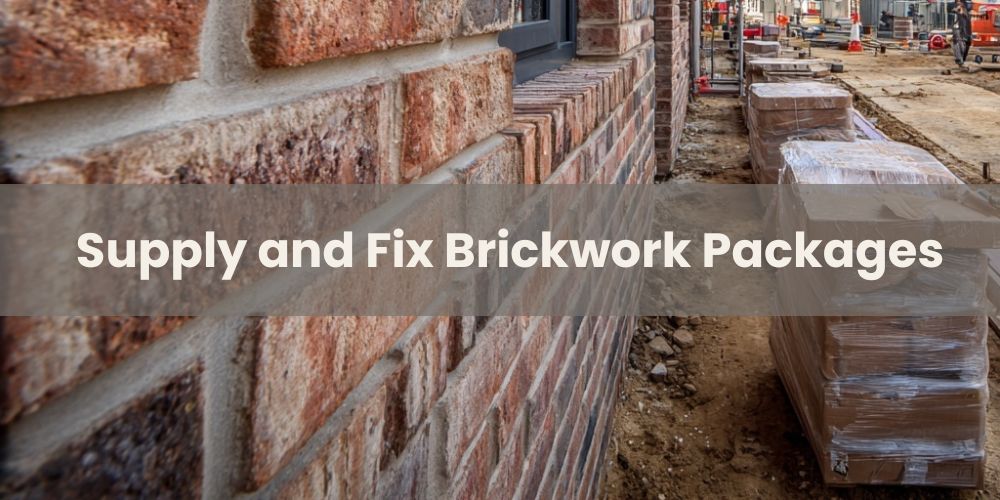
Brickwork Contractors London provides supply and fix brickwork packages for commercial construction, refurbishment, extension, facade, boundary, and masonry repair projects across London and the South East. Supply and fix brickwork packages combine material procurement, brick selection, block supply, mortar specification, labour allocation, setting-out control, access planning, sequencing, installation quality, protection measures, and handover checks into one coordinated masonry delivery route. The service is used where commercial brickwork must be sourced, delivered, built, inspected, and released as a complete package rather than split between separate material suppliers, labour teams, and site coordination decisions.
Supply and fix brickwork packages in London and the South East operate under commercial conditions that directly affect procurement accuracy, buildability, programme certainty, material compatibility, and finished masonry quality. Inner London projects often involve retained facades, occupied frontages, pavement-facing elevations, restricted scaffold positions, limited storage, tight delivery windows, older brick stock, live entrances, and party-wall edges where incorrect material supply or weak sequencing can quickly create delay and disruption. Outer London and South East commercial settings often involve larger wall runs, school extensions, office refurbishments, warehouse elevations, business park units, service-yard walls, boundary masonry, and phased commercial works where brickwork supply must align with groundworks, steelwork, roofing, glazing, drainage, M&E, cladding, render, external works, and internal fit-out. In these conditions, supply and fix brickwork performance is determined by how accurately the package defines materials, labour, access, wall sequence, interface requirements, and inspection points before construction begins.
- Material supply accuracy and brick compatibility → supply and fix brickwork depends on selecting the correct brick type, block type, mortar profile, colour range, texture, size, strength, absorption behaviour, frost resistance, and compatibility with existing or adjoining masonry → defects increase when bricks are ordered generically, replacement units do not match retained fabric, mortar is incompatible, or material tolerances are not checked before installation → visible mismatch, weak junctions, hard-repair damage, delayed starts, excess waste, and avoidable rebuilding develop.
- Procurement timing and site delivery control → commercial brickwork delivery depends on lead times, pallet sequencing, storage space, access routes, lifting method, scaffold reach, unloading windows, protection from weather, and the ability to move materials from delivery point to wall face without disrupting site operations → programme risk increases when materials arrive too early, arrive incomplete, block live access, exceed storage capacity, or reach site before the correct wall zone is ready → damaged units, lost labour time, blocked entrances, handling inefficiency, delivery conflict, and stalled masonry progress increase.
- Labour coordination and installation sequence → the fix element depends on matching bricklayers, blocklayers, repair operatives, supervisors, and support labour to wall type, bond pattern, opening layout, access condition, finish standard, and trade programme → poor outcomes develop when labour is allocated without separating new brickwork, blockwork, facade repair, infill masonry, boundary walls, architectural details, or occupied-site constraints → uneven workmanship, weak productivity, missed hold-points, repeated snagging, trade clashes, and poor handover quality increase.
- Setting out, openings, and interface readiness → supply and fix brickwork must coordinate wall lines, datums, first courses, DPC levels, cavity widths, lintel positions, reveals, movement joints, service penetrations, new-to-existing junctions, and follow-on trade tolerances before brickwork is built → defects occur when the package supplies materials and labour but does not control the dimensional and interface conditions that determine whether the wall can be completed correctly → misaligned openings, poor frame fit, bridged cavities, weak junctions, delayed glazing, and repeated making-good develop.
- Weather protection, curing, and finish control → completed brickwork depends on suitable curing conditions, protected wall heads, clean faces, compacted joints, consistent pointing, controlled wash-down, protected materials, and inspection before scaffold removal or trade release → quality declines when new masonry is exposed to rain, frost, contamination, premature loading, poor cleaning, or follow-on trades before joints, details, and protection measures are complete → washed joints, staining, frost damage, inconsistent finish, water entry, and snagging disputes increase.
- Commercial-site coordination and handover reliability → supply and fix brickwork packages must work around live entrances, tenants, public edges, service yards, stock areas, school circulation, office occupation, warehouse operations, fire routes, and neighbouring premises while still meeting construction programme requirements → project failure occurs when the masonry package is priced or delivered as a simple wall build without controlling access, safety, protection, material flow, inspection stages, and trade release points → tenant disruption, unsafe circulation, blocked operations, delayed follow-on trades, access return costs, and incomplete masonry closeout increase.
Brickwork Contractors London delivers supply and fix brickwork packages as a complete masonry procurement and installation service, assessing project scope, wall type, brick and block requirements, mortar compatibility, material availability, access constraints, delivery sequencing, scaffold reach, labour skill mix, setting-out needs, DPC and cavity details, openings, lintels, movement joints, new-to-existing junctions, weather exposure, trade dependencies, live-site restrictions, inspection hold-points, and handover standards before defining the correct supply route, fixing sequence, quality-control process, and completion strategy.