
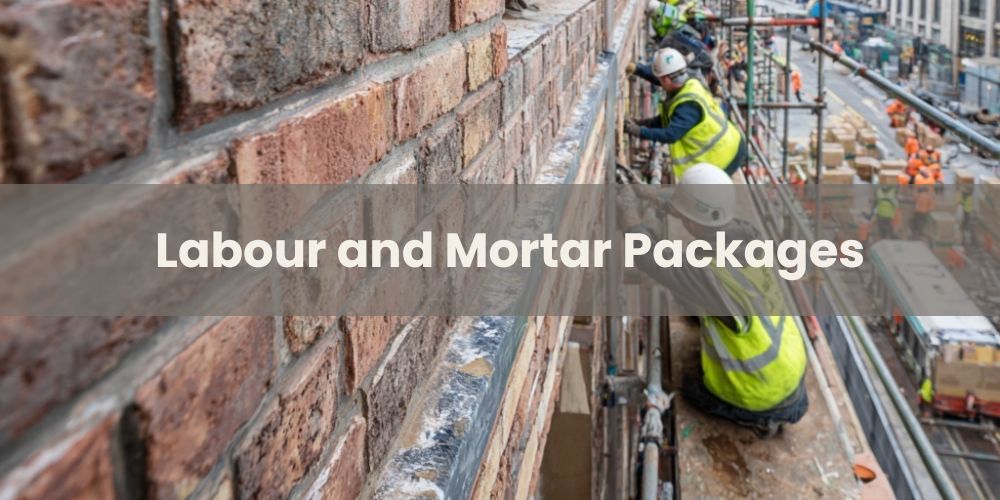
Brickwork Contractors London provides labour and mortar packages for commercial masonry projects across London and the South East. Labour and mortar packages combine skilled bricklaying labour, mortar specification, batching control, site sequencing, access planning, material handling, joint finish standards, weather protection, and handover checks into one coordinated masonry delivery package. The service is used where brickwork, blockwork, repointing, rebuilding, facade repair, boundary walling, internal blockwork, structural masonry repair, architectural masonry, or new commercial wall construction depends on the right workforce, the right mortar, the right work sequence, and the right quality controls being in place before masonry work begins.
Labour and mortar packages in London and the South East operate under site conditions that directly affect productivity, mortar performance, finish consistency, defect risk, and programme reliability. Inner London projects often involve occupied frontages, retained facades, pavement-facing elevations, restricted scaffold positions, tight storage, limited mixing areas, live entrances, upper-floor occupation, party-wall edges, and narrow delivery windows where labour movement and mortar use must be tightly controlled. Outer London and South East commercial settings often involve larger wall runs, school extensions, office refurbishments, warehouse frontages, business park units, boundary walls, service-yard masonry, and phased commercial projects where labour output must coordinate with groundworks, steelwork, roofing, glazing, drainage, M&E, cladding, render, external works, and internal fit-out. In these conditions, labour and mortar package performance is determined by workforce suitability, mortar compatibility, batching consistency, access logistics, curing protection, inspection discipline, and the ability to release completed masonry areas without slowing the wider project.
- Skilled labour allocation and masonry task fit → commercial masonry performance depends on matching bricklayers, blocklayers, repointers, repair operatives, working supervisors, and support labour to the actual wall type, repair scope, access condition, finish standard, and programme pressure → defects and delays increase when labour is allocated generically without separating new build brickwork, blockwork, facade repair, repointing, structural masonry, architectural detailing, or occupied-site working conditions → poor productivity, uneven workmanship, weak sequencing, repeated snagging, and avoidable programme friction develop.
- Mortar specification and material compatibility → labour and mortar packages must align mortar strength, permeability, colour, aggregate, workability, curing behaviour, joint profile, and brick or block compatibility with the wall’s age, exposure, function, and finish requirement → masonry failure occurs when mortar is too hard for older brick, too weak for exposed commercial conditions, visually inconsistent, poorly matched to existing joints, or unsuitable for the moisture behaviour of the wall → open joints, trapped damp, hard-repair damage, colour mismatch, premature pointing failure, and visible patching increase.
- Batching, mixing, and site-use control → mortar performance depends on consistent batching, clean mixing areas, correct water control, usable working time, protected storage, contamination avoidance, and reliable movement from mixing point to wall face → quality drops when mortar is mixed inconsistently, over-wetted, left exposed, moved too far across constrained sites, contaminated by waste routes, or used outside suitable weather and curing conditions → weak joints, staining, inconsistent colour, poor bond, washed pointing, and early repair failure develop.
- Access, sequencing, and commercial-site logistics → labour output depends on scaffold reach, safe circulation, material hoisting, delivery timing, exclusion zones, welfare planning, waste removal, protection measures, and clear release points for follow-on trades → project risk increases when bricklaying or repointing crews are placed into live commercial areas without coordinated access, material flow, tenant protection, noise control, dust control, or inspection timing → blocked entrances, slow production, damaged finishes, tenant disruption, trade clashes, and scaffold return costs increase.
- Joint finish, curing, and quality release → completed masonry depends on compacted joints, consistent pointing profile, correct curing, protected wall heads, clean faces, aligned courses, stable corners, completed openings, and checked interfaces before the area is handed over → defects appear when labour finishes wall areas without confirming joint depth, curing conditions, weather cover, sample standard, DPC and tray interfaces, service penetrations, movement joints, or adjoining trade readiness → inconsistent finish, water entry, cracked joints, staining, snagging disputes, delayed handover, and repeat remedial visits increase.
Brickwork Contractors London delivers labour and mortar packages as a controlled masonry delivery service, assessing project scope, wall type, brick and block requirements, repair method, mortar compatibility, labour skill mix, batching arrangement, scaffold access, material movement, sequencing constraints, weather exposure, live-site restrictions, joint finish standards, inspection hold-points, trade dependencies, and handover requirements before defining the correct labour allocation, mortar specification, working sequence, quality-control process, and completion strategy.