
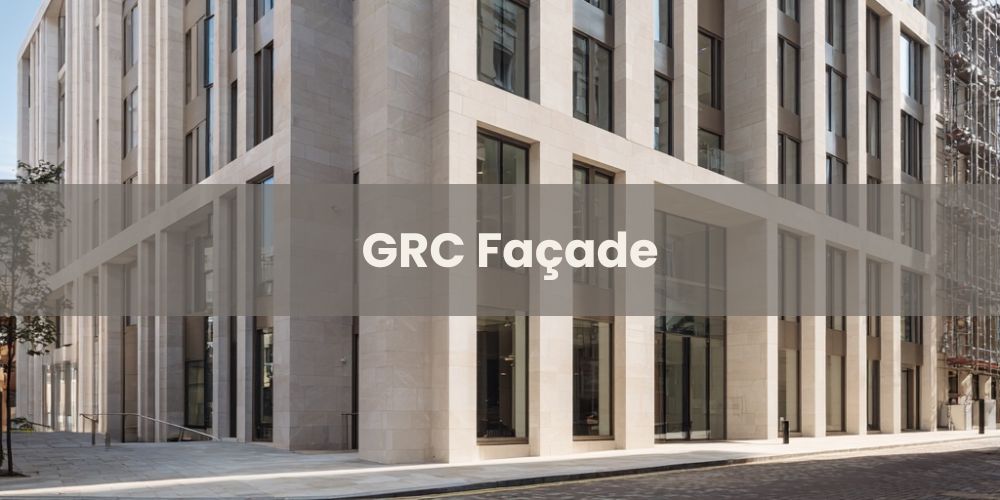
Brickwork Contractors London provides GRC facade design coordination, installation, repair, replacement, and interface detailing for commercial buildings across London and the South East. A GRC facade uses glass reinforced concrete panels, profiles, cornices, columns, cladding units, decorative bands, parapet features, soffit returns, entrance surrounds, and lightweight architectural elements to create a concrete-faced external finish without the mass of traditional cast stone or full-depth masonry. System performance depends on panel manufacture, fixing design, bracket alignment, backing structure, movement joints, sealant lines, drainage paths, fire-stopping interfaces, air and vapour control, lifting sequence, tolerance control, and how the GRC elements connect with brickwork, stonework, glazing, roofing, cladding, render, insulation, M&E penetrations, and internal fit-out.
GRC facade work in London and the South East operates under conditions that directly affect fixing security, panel alignment, joint movement, weather resistance, access planning, and long-term facade durability. Inner London projects often involve retained elevations, occupied frontages, restricted scaffold positions, pavement-facing facades, tight lifting zones, upper-floor occupation, party-wall edges, and commercial entrances where lightweight facade elements must be installed or repaired without destabilising live use. Outer London and South East commercial settings often involve larger elevations, business park buildings, school and office extensions, hospitality refurbishments, warehouse office fronts, boundary-facing facades, and commercial additions where GRC must coordinate with structural frames, masonry backing, glazing systems, roof edges, drainage, cladding rails, insulation zones, signage, lighting, M&E routes, and fire-stopping requirements. In these conditions, GRC facade performance is determined by how accurately panels are set out, how securely they are fixed, how movement is absorbed, how water is drained, and how visible joints, returns, corners, and material transitions are controlled.
- Lightweight panel fixing and structural support → GRC facade performance depends on secure brackets, anchors, rails, backing structure, fixing depth, edge distance, panel weight, lifting points, and load transfer into the supporting wall or frame → defects develop when fixings are misaligned, substrates are weak, bracket tolerances are exceeded, anchors are overloaded, or panel loads are not coordinated with the structural backing → loose panels, cracked units, unsafe facade conditions, distorted joints, and premature replacement risk increase when fixing design is not verified before installation.
- Panel alignment and visible facade geometry → GRC panels, profiles, cornices, returns, reveals, column casings, soffit edges, and decorative bands require precise setting out because small tolerance errors become visible across commercial elevations → visual failure occurs when panel joints wander, corner lines drift, reveals do not align with glazing, replacement units differ in profile, or large facade areas are installed without consistent datum control → poor facade rhythm, uneven shadow lines, snagging disputes, visible patching, and avoidable reinstallation increase.
- Movement, jointing, and sealant performance → GRC facade elements move in relation to steel frames, concrete structures, masonry backing, insulation layers, glazing systems, temperature change, wind load, and building movement → cracking begins when movement joints are too tight, sealants are unsuitable, rigid interfaces are forced, panels bridge structural movement, or long runs are detailed without enough tolerance → cracked panels, open joints, failed sealant lines, water entry, and repeated facade repair conditions develop.
- Moisture control and drained facade behaviour → GRC facade systems must manage rainwater through panel falls, open joints, sealant lines, cavity ventilation, drainage paths, flashings, sill interfaces, parapet edges, roof abutments, and wall-base details → water-related defects occur when joints trap moisture, drainage gaps are blocked, flashings are missed, backing walls are left exposed, or panel edges direct water into adjoining masonry and openings → staining, damp tracking, corrosion at fixings, substrate wetting, frost damage, and recurring leak investigations increase.
- Material interfaces and commercial building integration → GRC facade work often meets brickwork, stonework, glazing, curtain walling, render, cladding, roofing, insulation systems, fire barriers, signage fixings, lighting points, service penetrations, and internal finish lines → interface failure develops when different materials move differently, fixing zones clash with services, fire-stopping is not coordinated, penetrations are cut late, or facade edges are handed over before adjoining trades confirm their tolerances → cracked transitions, open edges, delayed trades, water-entry points, damaged panels, and incomplete facade performance increase.
Brickwork Contractors London delivers GRC facade work as a coordinated lightweight facade-system service, assessing panel type, support structure, fixing method, bracket layout, substrate condition, setting-out tolerances, movement joints, sealant specification, drainage routes, fire-stopping interfaces, panel replacement needs, visible finish requirements, lifting access, scaffold constraints, commercial occupancy, and adjoining trade interfaces before defining the correct installation, repair, replacement, remediation, restoration, or facade-integration strategy.