
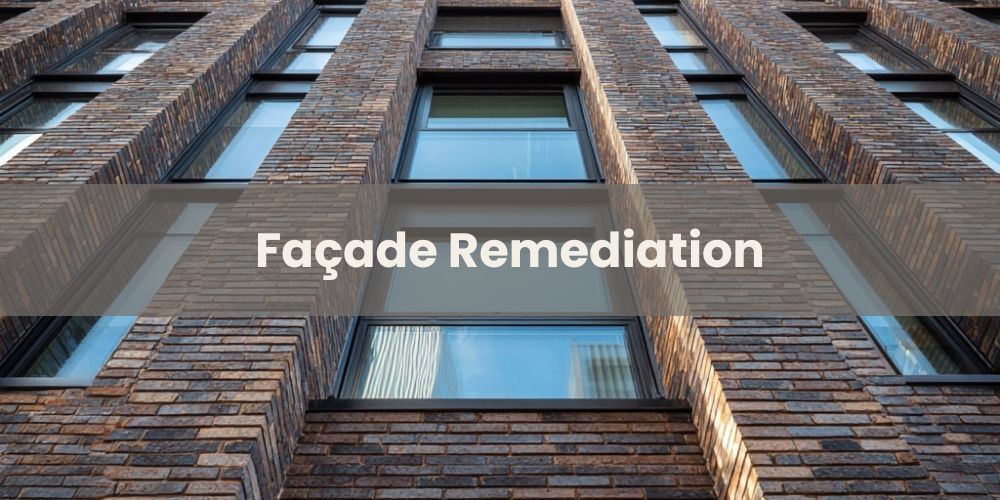
Brickwork Contractors London provides facade remediation assessment, repair, restoration, replacement, and interface coordination for commercial buildings across London and the South East. Facade remediation addresses external wall defects where brickwork, stonework, blockwork, mortar joints, cavity zones, wall ties, lintels, parapets, copings, openings, render edges, cladding junctions, service penetrations, roof abutments, drainage details, and previous repairs are no longer performing as a stable, weather-resistant, visually coherent building envelope. It is not cosmetic facade improvement. It is the process of identifying why a commercial facade is failing, how far the defect has spread, which wall components are affected, and what repair pathway will restore durability, safety, moisture control, and long-term building-fabric performance.
Facade remediation in London and the South East operates under conditions that directly affect diagnosis, access, sequencing, material compatibility, and repair durability. Inner London projects often involve retained elevations, occupied frontages, older brick and stone facades, altered shopfronts, pavement-facing walls, restricted scaffold positions, party-wall edges, upper-floor occupation, historic repair layers, and commercial entrances that cannot be disrupted without operational consequence. Outer London and South East commercial settings often involve larger facade areas, warehouse frontages, business park assets, school and office buildings, hospitality refurbishments, industrial boundary walls, service-yard elevations, and commercial extensions where external wall repair must coordinate with glazing, roofing, drainage, cladding, render, M&E, signage, insulation, fire-stopping interfaces, and internal fit-out. In these conditions, facade remediation performance is determined by how accurately the defect source is diagnosed, how compatible the repair materials are, how moisture and movement are controlled, and how safely the work is sequenced around commercial use.
- Weather-facing facade deterioration → exposes brickwork, stonework, mortar joints, parapets, copings, sills, plinths, and wall heads to rain, frost, pollution, wind pressure, splashback, and repeated wet-dry cycling → facade defects accelerate when open joints, spalled units, loose copings, failed pointing, cracked render edges, blocked weeps, or saturated wall heads are treated as isolated surface issues → water ingress, damp staining, frost damage, falling-material risk, and progressive external wall decay increase when facade remediation is not diagnosed at wall-system level.
- Older retained fabric and incompatible previous repairs → create repair complexity where original brick, stone, lime mortar, cement repointing, patch rebuilding, surface coatings, metal fixings, movement cracks, and later facade alterations interact within the same elevation → remediation fails when replacement materials, mortar strength, cleaning methods, sealants, or coatings are selected without respecting wall age, permeability, bond pattern, moisture behaviour, and visual continuity → hard-repair damage, trapped damp, salt staining, visible patch lines, recurring cracks, and premature facade failure develop.
- Openings, junctions, and interface defects → concentrate facade risk around windows, doors, shopfronts, loading bays, sills, lintels, reveals, frame edges, service penetrations, signage fixings, roof abutments, drainage outlets, render stops, cladding edges, and material transitions → local failures expand when weak junctions allow water, air movement, thermal bridging, frame distortion, cavity interruption, or movement stress to bypass the external wall face → damp reveals, frame-edge leaks, draught paths, cracked returns, failed sealant lines, and repeated making-good conditions increase.
- Movement, restraint, and structural facade behaviour → affects facades through wall-tie corrosion, lintel distress, parapet movement, bowing masonry, settlement cracks, thermal expansion, vibration, long elevation stress, new-to-existing junction movement, and restraint loss behind the visible surface → repair risk increases when cracks are filled, repointed, rendered, or patched without identifying whether the wall is moving, restrained, saturated, corroding, or poorly supported → recurring cracking, displaced masonry, unstable high-level details, hidden restraint failure, and unsafe facade conditions remain unresolved.
- Commercial access, occupancy, and multi-trade sequencing → shape how facade remediation is inspected, protected, scaffolded, repaired, cleaned, and handed over around live entrances, tenant areas, public edges, stock zones, service yards, rooflines, glazing teams, drainage works, cladding interfaces, M&E routes, and internal finishes → project failure occurs when external wall repair is technically correct but not coordinated with access constraints, commercial opening hours, weather windows, temporary protection, follow-on trades, or inspection hold-points → tenant disruption, blocked access, damaged finishes, delayed trades, scaffold return costs, and incomplete remediation outcomes increase.
Brickwork Contractors London delivers facade remediation as a diagnostic external-wall recovery service, assessing facade condition, masonry stability, brick and stone compatibility, mortar performance, moisture routes, wall tie risk, lintel and opening behaviour, parapet and coping condition, DPC and cavity tray continuity, drainage influence, movement cracks, previous repair history, access constraints, commercial occupancy, and adjoining trade interfaces before defining the correct repointing, brick replacement, stone repair, local rebuilding, wall-tie remediation, parapet repair, opening correction, junction remediation, facade restoration, or wider external wall repair strategy.