
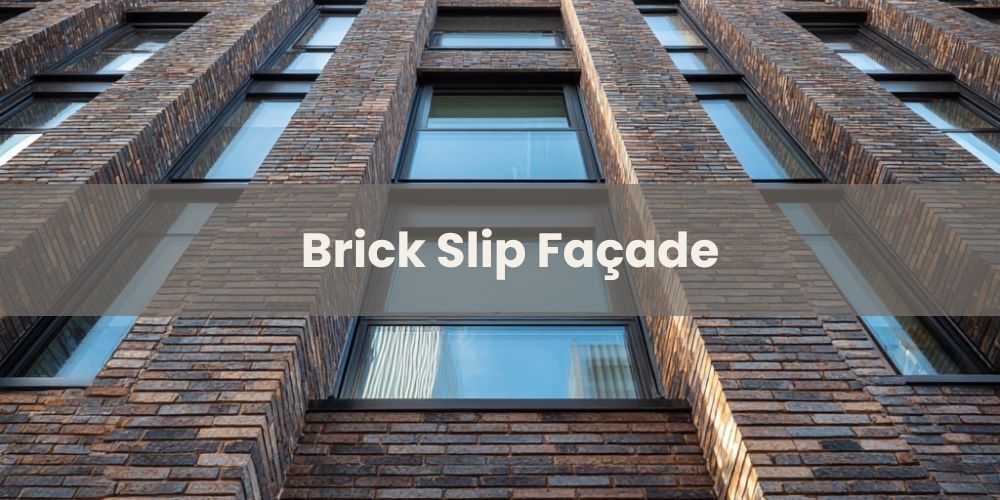
Brickwork Contractors London provides brick slip facade design coordination, installation, repair, replacement, and detailing for commercial buildings across London and the South East. A brick slip facade uses thin brick units fixed to a backing system to create a brick-faced external elevation without relying on full-depth traditional brickwork. System performance depends on the relationship between brick slips, adhesive or fixing method, carrier board, backing substrate, support rails, insulation zone, movement joints, pointing profile, corner slips, reveals, plinths, parapet edges, fire-stopping interfaces, drainage paths, ventilation gaps, and adjoining facade materials.
Brick slip facade work in London and the South East operates under conditions that directly affect bond strength, visual alignment, moisture behaviour, movement tolerance, and long-term facade durability. Inner London projects often involve retained elevations, occupied frontages, tight scaffold positions, pavement-facing facades, altered shopfronts, upper-floor occupation, restricted storage, and commercial entrances where the finished brick appearance must be achieved without disrupting live use. Outer London and South East commercial settings often involve larger elevations, business park units, warehouse office fronts, school extensions, hospitality refurbishments, lightweight facade upgrades, boundary-facing walls, and commercial additions where brick slips must coordinate with insulation systems, cladding rails, glazing, render, roofing, drainage, signage, M&E penetrations, and internal fit-out. In these conditions, brick slip facade performance is determined by how accurately the backing system is prepared, how consistently slips are bonded or fixed, how joints are pointed, and how the facade manages movement, moisture, fire interfaces, and exposed commercial use.
- Backing system accuracy and substrate condition → brick slip facade performance depends on a stable backing board, suitable substrate, correct carrier system, flat fixing plane, secure support rails, and compatible adhesive or mechanical fixing method → defects develop when brick slips are installed over uneven, damp, moving, weak, contaminated, or poorly aligned backgrounds → debonding, lipping, hollow sections, cracked joints, uneven courses, and premature facade failure increase when the backing system is not verified before installation.
- Visible alignment across commercial elevations → brick slip facades place high visual demand on course rhythm, joint width, slip spacing, corner formation, reveal setting, plinth alignment, soldier details, and transition into adjoining materials → small setting-out errors become obvious across shopfronts, entrance elevations, office frontages, hospitality facades, and larger commercial wall faces → poor bond rhythm, misaligned reveals, inconsistent jointing, patchwork appearance, snagging disputes, and avoidable replacement increase when the facade is not controlled as a visible masonry system.
- Moisture movement and facade drainage → brick slip systems must manage rain exposure, pointing continuity, capillary movement, drained cavities, ventilation zones, sill details, parapet edges, plinths, sealant lines, and junctions with glazing, render, cladding, and roof abutments → water-related failure develops when joints open, backing boards retain moisture, cavity paths are blocked, slips bridge drainage zones, or edges are sealed without allowing controlled drying → staining, trapped damp, adhesive breakdown, frost damage, efflorescence, and recurring facade repair conditions increase.
- Thermal movement and material compatibility → brick slips, adhesives, carrier boards, insulation, metal rails, sealants, backing substrates, render edges, glazing frames, and structural supports all expand, contract, and move at different rates → cracking occurs when movement joints are omitted, rigid junctions are forced, incompatible materials are combined, or long facade runs are treated like traditional bonded brickwork → cracked pointing, loose slips, stressed corners, failed sealants, open transitions, and repeated repair lines develop.
- Openings, penetrations, and edge detailing → brick slip facades become vulnerable around windows, doors, shopfronts, vents, ducts, lighting points, signage fixings, service penetrations, parapets, soffits, corners, plinths, and return edges → failure risk increases when slips are cut poorly, fixings interrupt the support system, reveals are not weathered, penetrations are not sleeved, or edge trims and sealants are treated as afterthoughts → water entry, broken slip edges, poor frame interfaces, loose corners, visible cuts, and localised facade weakness increase.
Brickwork Contractors London delivers brick slip facade work as a coordinated facade-system service, assessing wall function, backing condition, carrier system, substrate suitability, insulation interface, slip selection, bond pattern, adhesive or fixing method, pointing profile, movement joints, moisture-control routes, fire-stopping interfaces, reveals, corners, plinths, parapet edges, service penetrations, access constraints, commercial occupancy, and adjoining trade interfaces before defining the correct installation, repair, replacement, remediation, or facade-integration strategy.