
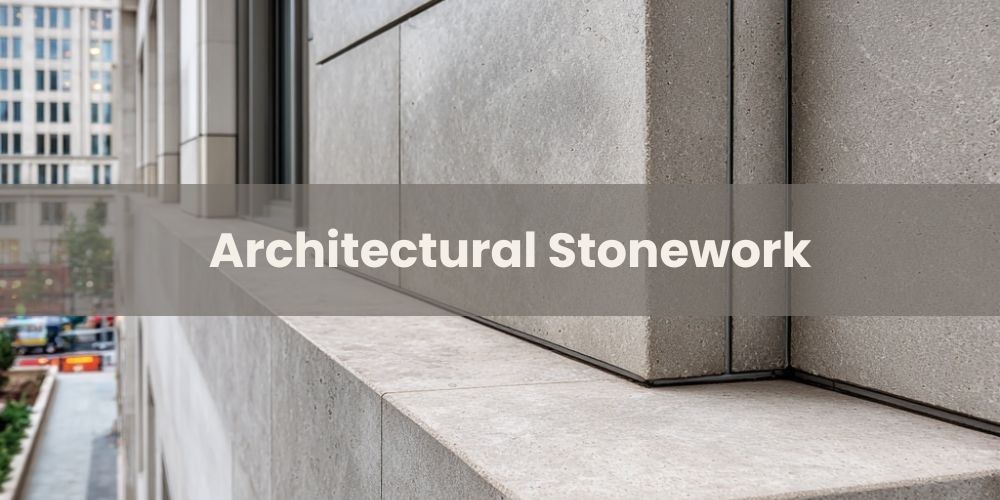
Brickwork Contractors London provides architectural stonework construction, repair, restoration, replacement, and detailing for commercial buildings across London and the South East. Architectural stonework is the controlled use of natural or manufactured stone within visible building elements where appearance, durability, weathering, fixing security, joint design, and compatibility with adjoining masonry all affect the finished commercial facade. It includes stone plinths, copings, string courses, window surrounds, entrance surrounds, lintels, sills, cornices, quoins, parapet stones, steps, thresholds, pier caps, wall caps, facade bands, decorative panels, and stone-to-brick junctions that must remain stable, weather-resistant, visually coherent, and suitable for the building’s use.
Architectural stonework in London and the South East operates under conditions that directly affect stone selection, bedding orientation, fixing method, joint profile, cleaning approach, moisture behaviour, and long-term facade performance. Inner London commercial buildings often involve retained stone details, older brick-and-stone facades, pavement-facing elevations, occupied frontages, restricted scaffold access, pollution staining, previous patch repairs, and entrance areas where stonework remains highly visible to customers, tenants, and the public. Outer London and South East commercial settings often involve larger commercial elevations, business park entrances, school and office extensions, hospitality refurbishments, boundary-facing walls, service-yard edges, and new facade additions where stonework must coordinate with brickwork, glazing, roofing, drainage, render, cladding, signage, lighting, M&E penetrations, and internal fit-out. In these conditions, architectural stonework performance is determined by how well the stone is selected, bedded, fixed, jointed, weathered, cleaned, protected, and integrated into the surrounding wall system.
- Visible entrance and facade stonework → makes stone colour, surface finish, arris sharpness, joint width, alignment, plinth level, sill projection, coping line, and decorative continuity commercially visible → small errors in stone matching, setting out, cutting, cleaning, or jointing become obvious around entrances, frontage returns, office elevations, hospitality facades, and retained commercial details → poor visual continuity, staining, chipped edges, snagging disputes, and avoidable replacement increase when architectural stonework is not controlled as a facade-quality system.
- Moisture exposure and stone weathering behaviour → places performance pressure on copings, sills, thresholds, plinths, wall caps, string courses, parapet stones, drip grooves, bed joints, pointing, and stone-to-brick junctions → stonework deteriorates when water is held on flat surfaces, drips are missing, joints open, salts crystallise, incompatible mortars trap moisture, or drainage details push water into the wall behind the stone → staining, surface erosion, frost damage, damp tracking, open joints, and recurring facade repair conditions develop.
- Older retained stone and adjoining masonry fabric → creates compatibility pressure between original stone, replacement pieces, brick backing, mortar permeability, metal cramps, fixings, previous repairs, movement cracks, cleaning residues, and modern adjoining materials → new or repaired architectural stonework can fail when it is fixed, bedded, pointed, or cleaned without respecting stone type, bedding plane, moisture movement, wall age, restraint condition, and visual transition → cracked units, rust staining, trapped damp, hard-repair damage, visible patching, and premature facade deterioration increase.
- Commercial access, fixing security, and interface coordination → affect how stone units are lifted, supported, anchored, protected, inspected, cleaned, and handed over around live entrances, scaffold zones, public edges, tenant areas, glazing lines, signage zones, lighting points, roof edges, and adjoining finishes → risk increases when stonework is installed or repaired without confirming bearing, restraint, fixing depth, movement allowance, access sequence, protection method, and follow-on trade interfaces → loose units, damaged edges, blocked access, delayed trades, unsafe facade details, and inconsistent completion quality increase.
Brickwork Contractors London delivers architectural stonework as a coordinated facade, detail, and wall-performance service, assessing stone type, wall function, visible finish requirements, bedding direction, unit condition, mortar compatibility, fixing security, joint profile, drip and water-shedding details, plinths, copings, sills, thresholds, parapets, entrance surrounds, stone-to-brick junctions, cleaning sensitivity, access constraints, trade interfaces, and commercial occupancy before defining the correct construction, repair, restoration, replacement, repointing, cleaning, or facade-integration strategy.