
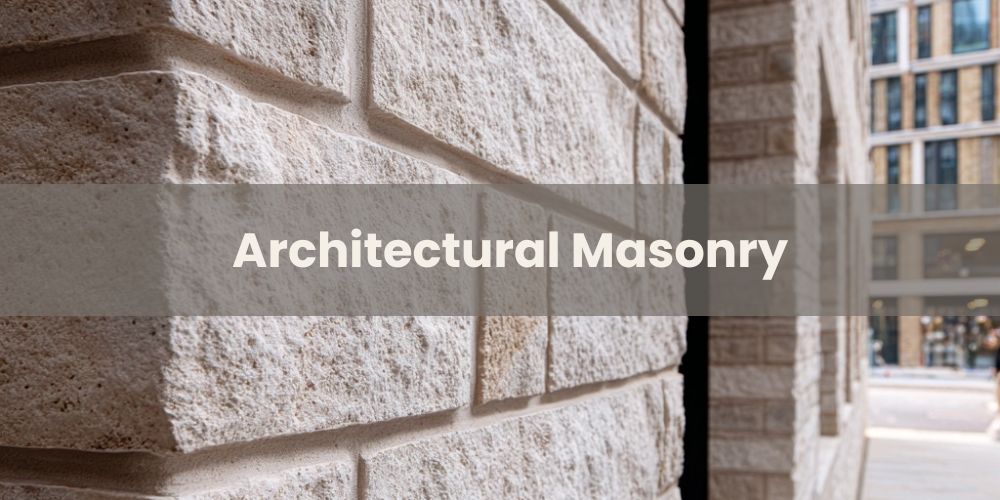
Brickwork Contractors London provides architectural masonry design coordination, construction, repair, restoration, and detailing for commercial buildings across London and the South East. Architectural masonry sits between structural walling, facade presentation, material compatibility, weather protection, and commercial building identity, so performance depends on more than laying brick, block, or stone to a visible line. Architectural masonry uses controlled brickwork, blockwork, stonework, bonding patterns, mortar profiles, reveals, arches, piers, parapets, copings, plinths, decorative courses, facade returns, opening surrounds, and material transitions to create masonry that is buildable, durable, visually coherent, and integrated with the wider commercial building fabric.
Architectural masonry in London and the South East operates under commercial conditions that directly affect finish quality, interface performance, and long-term facade durability. Inner London projects often involve retained facades, occupied frontages, pavement-facing elevations, restricted scaffold positions, older brick stock, altered openings, party-wall edges, and entrances that must remain usable during the works. Outer London and South East commercial settings often involve larger elevations, business park frontages, warehouse office sections, school extensions, hospitality refurbishments, boundary-facing walls, service-yard elevations, and new commercial additions where masonry must coordinate with glazing, roofing, cladding, render, drainage, M&E, signage, and internal fit-out. In these conditions, architectural masonry performance is determined by how accurately the visible masonry is set out, how well materials are matched, how openings and junctions are detailed, and how the finished elevation manages movement, moisture, access, and commercial use.
- Public-facing commercial elevations → make bond rhythm, brick tone, joint profile, reveal accuracy, corner quality, plinth alignment, and facade continuity commercially visible → small dimensional or material errors become obvious across entrances, frontage returns, office elevations, hospitality facades, and retained brickwork → visual inconsistency, poor frontage quality, snagging disputes, and avoidable rebuilding increase when architectural masonry is not controlled at detail level.
- Older retained masonry and new facade work → create compatibility pressure between existing brick, replacement units, mortar hardness, lime or cement behaviour, previous repairs, movement cracks, damp routes, and modern adjoining materials → new architectural masonry can fail when it is tied into retained fabric without respecting brick size, bond pattern, permeability, wall thickness, weathering behaviour, and visual transition → weak junctions, trapped moisture, hard-repair damage, visible patch lines, and premature facade deterioration increase.
- Live commercial access and restricted working zones → affect how architectural masonry is sequenced, protected, inspected, cleaned, and handed over around entrances, tenant areas, scaffold zones, delivery routes, public edges, and occupied interiors → masonry work becomes higher risk when sample panels, material storage, cutting zones, pointing, temporary protection, and follow-on trades are not coordinated around site use → blocked access, damaged finishes, tenant disruption, delayed trades, and inconsistent completion quality increase.
- Openings, weathering details, and facade junctions → place continuous performance pressure on sills, reveals, lintels, copings, parapets, DPCs, cavity trays, weeps, service penetrations, render stops, cladding edges, signage fixings, and roof abutments → architectural masonry loses long-term performance when visible detailing is prioritised without controlling water shedding, damp separation, movement allowance, and interface continuity → staining, damp tracking, cracked edges, failed joints, and recurring facade repair conditions develop.
Brickwork Contractors London delivers architectural masonry as a coordinated facade and wall-performance service, assessing wall function, visible finish requirements, brick and stone compatibility, mortar profile, bond pattern, setting-out accuracy, opening details, moisture-control routes, movement joints, parapets, copings, plinths, access constraints, trade interfaces, and commercial occupancy before defining the correct construction, repair, restoration, repointing, rebuilding, or facade-integration strategy.